

Before you start
- A Google login with access to the ad accounts. Cometly lists the Google Ads accounts your login can open directly, plus the enabled accounts under any manager (MCC) account it can open. Test accounts are not listed.
- The Administrator or Advertiser role in the Cometly space (a space is a workspace in your Cometly account, with its own tracking, ad accounts and reports).
- The Cometly pixel (the tracking script that records your visitors) on your landing pages. See Install the pixel.
Connect Google Ads
1
Open the Google Ads row
In Cometly, click Integrations in the left sidebar and find Google Ads under Ad Platforms.
2
Sign in with Google
Click Sign in with Google. A pop-up window opens on Google. Choose your Google account and allow Cometly to access Google Ads. When the window comes back to Cometly, click Done to close it.
3
Find your ad accounts
The row expands and the Ad Accounts table lists every account your Google login can access. Use Search ad account to find one. Manager accounts carry an MCC badge, and the accounts under a manager are listed as their own rows.
4
Connect each ad account to the space
In the space the account should report into, click Connect & Sync Data next to it. You see Ad Account Connected - Data will sync in 30-60 minutes.
Check it worked
The account now shows Connected with the space’s name in the Space column, and it appears in the Connected Google Ad Accounts card, where everyone in the space can see who connected it. Within 30 to 60 minutes, your active campaigns start to appear in the Ads Manager with their spend.Your Google sign-in is personal: only you can see and manage it. An ad account can be connected to one space at a time. See Same ad account in two spaces.
Add Cometly’s URL parameters
Google Ads carries Cometly’s parameters in a tracking template. Use the one that matches the campaign type. Search, Display, Discovery, Demand Gen, Shopping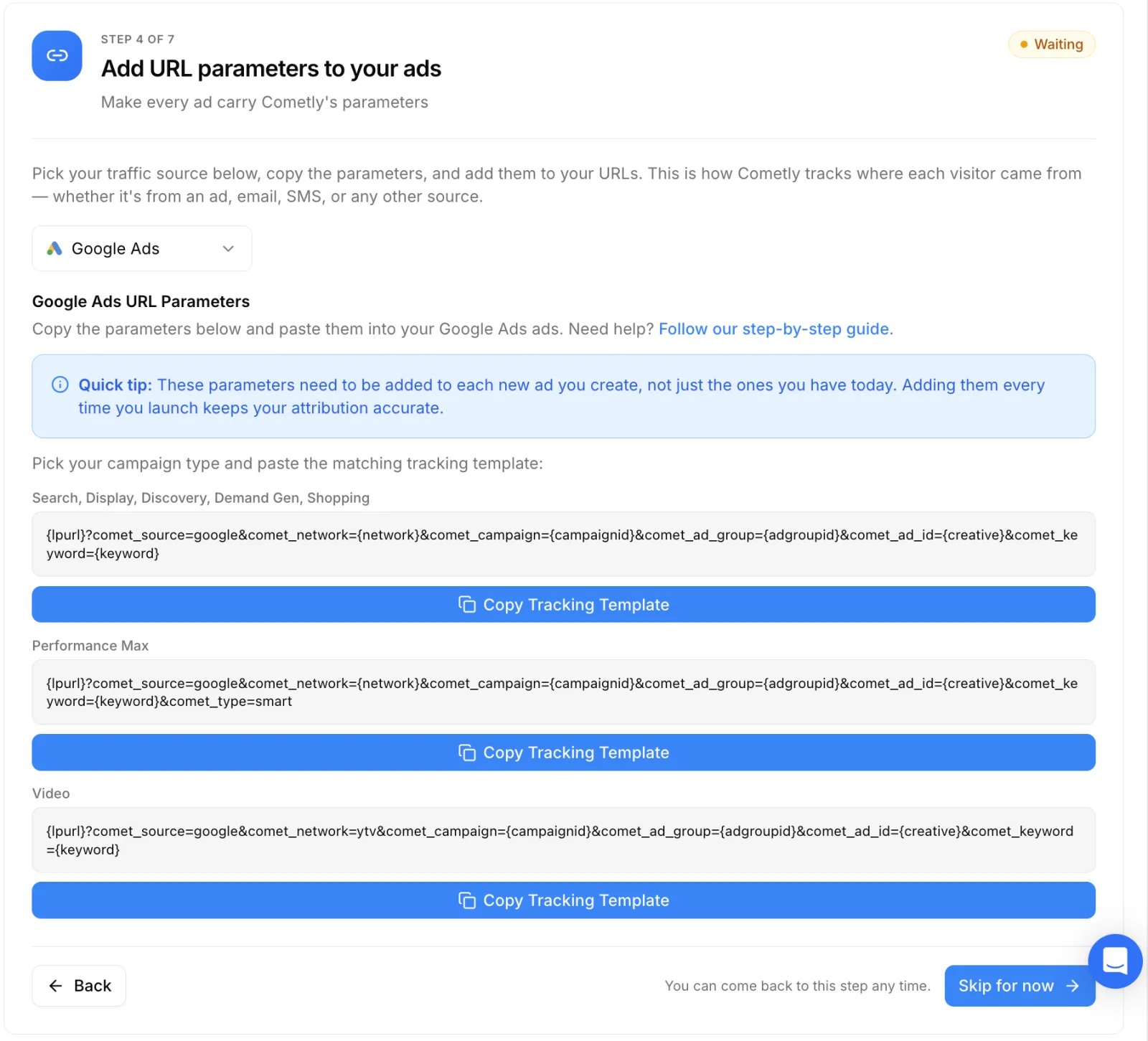
- It reads the tracking template and the final URL suffix on the ad, ad group, campaign and account, and applies the lowest level that has one. A template on an ad or ad group overrides the campaign’s.
- An active ad whose landing page does not receive Cometly’s parameters gets a red dot with the tooltip UTM Setup Error in the Ads Manager. Performance Max campaigns only pass with
comet_type=smart. Call ads and app campaigns have no landing page, so they are never flagged. - To see what each level carries, add the URL Params column from the Columns menu. An account-level template is shown above the table, next to Account URL Params:.
Send conversions back (Conversion API)
The Google section of the Conversion API (Events Manager, then the Conversion API tab) sends your Cometly events to Google Ads as offline conversions. You create offline conversion actions in Google Ads, turn on data sharing, and map each action to a Cometly event with a rule: Send all events or Only send attributed events. See Configure the Google Conversion API.What to expect after connecting
- Data. Active campaigns start populating within 30 to 60 minutes. After that, Cometly refreshes Google Ads data every 30 minutes and pulls each of the previous four days again twice a day, so Google’s later adjustments are captured.
- Campaigns. New campaigns are picked up automatically while Auto-track new campaigns is on (Settings, then Campaign tracking under Workspace). If a campaign that was already running is missing, see Manually turn on tracking.
- Status. The row shows Connected, or Connection Issue, Resync Required when Cometly cannot load your ad accounts from Google: click Resync to sign in again (see Ad data not syncing). Last Synced is the last time you signed in to Google from this row, not the time of the last data refresh.
- Disconnect. At the top of the expanded row it removes your Google profile, and ad data stops tracking immediately in every space that uses its ad accounts. Next to one ad account it removes only that account from its space.
Troubleshooting
You received an “Action Required” notification
When a sync fails, Cometly posts a notification in the space and sends it by email. Each one has its own fix:
Syncing resumes on its own after the fix. You then get Google Connection Restored, and the last 48 hours of data are restored automatically.
An ad account is missing from the list
Sign in with a Google login that can open the account, directly or through a manager account, then click Resync. An account that already shows Connected with another space’s name must be disconnected there first.Ads show a UTM Setup Error
Look for a different template lower down: see Check for Google tracking templates at the ad group or ad level. For Shopping ads, see Fix URL parameters in Google Merchant Center.Frequently asked questions
Does Cometly import historical Google Ads data?
No. Cometly tracks a campaign from the moment its tracking is turned on, and from that point forward, so campaigns are not tracked retroactively. To turn on tracking for campaigns that were already running, see Tracking historical ad data.How do I remove Cometly’s access to my Google Ads account?
In Cometly, click Disconnect at the top of the expanded Google Ads row to remove your Google profile. To revoke the access on Google’s side as well, delete the Cometly connection in your Google Account settings. See Remove Cometly access from your Google Ads account.Why don’t Cometly and Google Ads conversion numbers match?
When you send conversions through the Conversion API, Google Ads reports each conversion on the date of the click, while Cometly reports it on the date the person converted. Google can also take 12 to 48 hours to process conversions it receives. Expect small differences even after that. See Google Ads conversion differences.Next steps
- Add Cometly’s tracking template to your Google campaigns
- Configure the Google Conversion API to send conversions back
- Review your Google campaigns in the Ads Manager
- See how often ad data updates in Cometly
- Contact support if a fix above does not work. Include the name of the Google Ads account, the status on the Google Ads row and the title of any notification you received.